Showing posts with label The Walking Dead. Show all posts

Sunday, 1 May 2011

GUEST BLOGGER: Arrest Those Zombies!: Policing The Undead


This week as well as our usual blog, we have a special guest blog from Amy Cutler of Passenger Films- one of the zombies arrested during our Royal Wedding celebrations on Friday. To find out more about the strange zombie happenings going on during the Royal Wedding, see our regular blog. Here, she shows us zombie movies have a lot to say about those events:

On Friday morning I attended a ‘Royal Zombie Wedding’ picnic, and was subsequently handcuffed and arrested in Soho Square (that’s me above), and spent the afternoon in a cell at Belgravia police station. While I was in my cell I thought a little harder about the link between zombies and the policing of cities. Here are some thoughts, followed by a call to arms for supporters of the undead!

Readers of Chris’s blog will no doubt be familiar with the importance of police in zombie films. Think of the pre-credit footage of riot police, soundtracked by Johnny Cash’s ‘The Man Comes Around’, in Dawn of the Dead. Or the use of riot police footage once again at the start of 28 Days Later, in which exposure to such television transmissions also means exposure to the transmission of ‘the rage virus’.

I’ve always been interested in zombie politics, which has an early model in Daniel Defoe’s A Journal of the Plague Year (1722), concerned with the 1665 bubonic plague in London and the effect of the ‘walking putrified carcasses’ which were the infected, and also the attempts by the mayor and the aldermen to police the situation. New legislation came out at the time to ‘prevent idle assemblies’ and therefore contagion, but there were plenty of instances of people ‘breaking out in Rabbles and Tumults’, just as the body breaks out in tokens of the plague. The behaviour of the sick and infected in the book poses a form of geographical insurrection, for ‘they were with great difficulty kept from running out into the Fields and Towns, and tearing all in pieces wherever they came’. Defoe is himself awed by the idea of a mob of people, as seen in his 1702 publication, ‘The Original Power of the Collective Body of the People of England’ (1702). He thought mobs to be the very antithesis of government. An example is when he called upon the House of Commons to pay attention to the Kentish petitioners, and signed his name ‘Legion’; he is clearly therefore very aware of the idea of people acting as a political force. It is also telling that it is the poor and labouring classes who are of the greatest importance in Plague Year, for they cannot afford to withdraw into isolation, but must continue to work and be mobile – and are thus most likely to be spreading the infection.

Zombie films learn from Defoe a fascination with the various meanings of the term break-out – the break out of disease, the break out of riots, and the break out of contained spaces such as shut up houses and jails. The administration that went on in trying to control the spaces of the city included the mayor’s orders forbidding the ‘multitude’ of rogues and ‘wandring Beggars’ from ‘swarming in every place about the city’, and the large scale incarceration of people within infected houses. Defoe quotes verbatim these rules for the regulation of the citizens. But he is also fascinated with the areas in which these policies fail or are ineffective. ‘There was just so many Prisons in the town as there were Houses shut up’, the narrator observes: yet over and over he tells stories of the people who broke out by force and stratagem, whether they found ways to unscrew locks, escape into one of the back streets, go over the rooftops, or break or throw themselves out of the windows.

It’s important to remember that Plague Year was written during a moment of crucial revision in men’s exercise of final authority over one another. Defoe constantly draws attention to the internal governance and state institutions that provide the matrix within which the spectacles and anecdotes of the plague take place. He adopts the conceit that fully deployed legal authority in the city turns its houses into prisons and its citizens into criminals. (When we talk about crime it’s important to note that Defoe has first-hand knowledge of the development of the penitentiary system at this time, as he’s actually been imprisoned on seven or eight occasions, both for debts and for libel in his work as a journalist.) This criminalisation of the infected is partly because, as Michelle Brandwein notes,

plague effectively turns crime and disease into identical things. A plague, as a contagious illness, breaks down the distinction between ordinary, non-contagious illness (understood as harmful only to the self) and crime (understood as harmful to others); because a plague is harmful to both the sick person and others it forms a bridge between illness and crime, and all who suffer from it are both victims and criminals at the same time.

In the modern zombie film, we see a similar concern with the political constructs behind the suppression of the zombie threat. In the sequence in the underpass in 28 Days Later, the running zombies are portrayed very much as an anonymous mob. None of them are discriminated from each other – instead, they herd as shadows towards the human agents in the scene; we hear the footsteps of a mob as one threatening sound. In 28 Weeks Later we again see the threat of the mob as something which has an uncontrollable and unmanageable element, and the efforts of the military or governmental agents to control the movement of people (as in some scenes they appear as little more than glorified traffic controllers). Concepts of border control, quarantining and containment are all subject to investigation in today’s political zombie film.

The perceived social wrongs which zombie films address have ranged from the colonial connotations of the early voodoo zombie films, the consumerism of mall society in Romero’s early films, and the various social divisions between ‘us’ and ‘them’ which are exhibited in the class and race tensions in Land of the Dead. We can witness that film’s interest in the policing of the divisions of the city space immediately in the poster, showing a disembodied zombie hand clinging to what we must surely guess is the wrong side of the fence.


Recent zombie films explicitly refer to particular governmental decisions. In Joe Dante’s Homecoming, the American Republican policy makers are flummoxed by the return of the Iraqi war dead, who begin to contradict patriotic narratives of the war (one declares on TV ‘I was killed for a lie’). These are speaking, thinking, harmless zombies, threatening only in the sense of the affect of their return on the government’s political agenda. Mark Peranson points out the overt links to the Bush administration:

Homecoming’s most stunning scene is the first appearance of the zombies at Dover Air Force base, as the undead soldiers emerge from beneath the American flags covering their coffins — the very scenes that the Pentagon has forbidden the media to cover. More than soldiers, though, the zombies represent all the disenfranchised, including those whose votes weren’t counted in both recent elections: as the undead eventually are allowed to go to the polls, and the results start swinging to the left, the Republicans make the call. Dante pulls no punches in declaring the fix was and still is in (after name-checking Florida, he even shows the classic “Dewey Defeats Truman” headline).

Here are the returned patriots posing before the flag:


Equally harmless zombies are the subjects of the recent French film Les Revenants (English title They Came Back). The use of zombies to show the return of the repressed, and entry into a Marcusian non-repressive civilization, is a familiar trope. In Revenants, the mayor of the town and the governmental and military representatives decide they cannot deal with the unsolicited returnees: the returned loved ones and family members are therefore, in a horrifying final sequence (spoiler alert!), gassed and returned to their graves (below). What better image for the suppression that society enacts, in order to ensure it continues to function? Or Kristeva’s image of the zombie as the ‘abject’ of society – that matter, such as dead bodies, or faeces, which must be ejected from society in an organised fashion. (I have to say I felt like a very abject zombie indeed in Cell no. 12 at Belgravia police station.)


If we’ve outgrown Romero’s consumerist zombies, then perhaps one of the still growing zombie themes is that of surveillance and its association with the policing of space. The use of CCTV in Diary of the Dead and 28 Weeks Later are cases in point; in the latter, we are even given the military’s gun-point of view, in a scene in which all discrimination between ‘friendlies’ and the infected is given up, and the soldiers are instructed to enforce the quarantine by shooting ‘anything that moves’.


This ‘anything that moves’ bring us to what I think is the most interesting form of policing – that is, policing movement. The threat of the mobile crowd, the threat of the mobile infection, and the threat of the mobile dead – nicknamed in recent TV series The Walking Dead simply as ‘walkers’ – invites, but also defies, arrest by the authorities. The zombies are defined not simply by being dead, but by being the moving dead, and to ‘arrest’ them would also to be, literally, to cease their motion. The idea of zombie arrest is very similar to the idea of the arrested, controlled society – most strikingly so when we consider the threat of the ‘mob’, and the link between ‘mob’ and ‘mobility’. From the Online Etymology Dictionary:

Mob, 1680s, "disorderly part of the population, rabble," slang shortening of mobile, mobility "common people, populace, rabble" (1670s), from L. mobile vulgus "fickle common people" (c.1600 in English), from mobile, neut. of mobilis "fickle, movable, mobile," from movere "to move" (see move).

I’ve begun to discuss this idea with some of my students. (I teach a couple of classes on film studies to third year geographers on the Mobilities course at Royal Holloway, where I’m doing my PhD.) Perhaps I’m even keener given that I’ve now been an arrested zombie myself. The full story of the day is given by Hannah, my fellow zombie convict, here.

What remains fascinating to me is the revival of some of the ideas I have been previously interested in, such as the portrayal in Homecoming of zombies versus the controlling political agendas hidden behind patriotism. In our case, on the day of the wedding the scene on street level was subject to severe editing by the police. We were fairly inoffensive members of the undead, who ate some homemade ‘brainnnsss’ cake earlier in the day, and travelled on to Starbucks where we sat down with some tea. At this point, four police vans (with sirens!) came round the corner and did a raid on Starbucks. We were stopped and searched under a special Section 60 for the wedding day – by sixteen police men, although there were only five zombies – and finally arrested and transported to the police station. This constituted a successful removal of what was seen as an ‘unseemly’ element of the day’s celebrations. Apparently, our fancy dress was too alternative to be tolerated. Even though, look, I was being patriotic – I even had a flag!

Footage of our arrest is on this video – you can watch us actually being handcuffed at seven minutes thirty seconds in.
I also found out afterwards that one of the camera men who filmed us being arrested was subsequently arrested himself! His account here.

Meanwhile, the good news of the day is that the zombie family I met (complete with two little zombies in prams, one holding a ‘princesses are pigs’ sign) apparently got away and danced the night away in Red Lion Square. And they’re reported here in the Guardian, saying that ‘anti-democratic, anti-egalitarian Britain (is) the land of the living dead’.

I made good friends with the other undead convicts, Ludi, Hannah, Deborah and Erich, all charming and creative people – Erich has coincidentally just run a zombie all-nighter at the London Indie Film Festival. We also managed to get the word zombies into the Guardian the following morning, in a quote in which I sound particularly harmless and simple-minded:

So, what next? We’re thinking of arranging a protest lurch. Please get in touch if you want to be involved (amycutler1985@gmail.com), and come and be a manacled zombie shuffling round Soho, in a walk in support of our right to be zombies whenever we goddamn like.

The perfect model, of course, is Bub from Day of the Dead, who I’ve saved for the end, as probably the most famous zombie prisoner. Don’t forget he ate through his manacles in the end though.


Tuesday, 19 April 2011

#15 Fido: I Don't Want You Thinking That What We Did is Normal or Okay

A film opens on two men robbing a darkened house. As they grab as many valuables as they can and stuff them into their swag bags, the window behind them is illuminated. The camera cuts to show a car pulling into the driveway. And the audience’s first thought is- get out of the house!

We’re talking about burglars stealing someone else’s stuff, and the audience is rooting for them to get away. Whenever it comes to storytelling, we’re willing to forgive all kinds of crap if the person doing it is the protagonist. That’s why Macbeth, a play about a good man who defeats the power-mad serial killer who murdered his wife and children, is known as a tragedy.

You can see this right across the zombie genre. It’s obvious nowhere more so than I Am Legend, but numerous times, in Dawn of the Dead, The Walking Dead, 28 Days Later and Braindead, we see our survivors doing completely bastard-like things which we’re happy to forgive, because we’re rooting for them.

Which brings us to our blog on the film that I believe is Billy Connolly’s greatest acting achievement, Fido. There will be spoilers (Also I spoiled Macbeth back there... sorry about that!)
Yeah, this shits all over Mrs Brown
Fido is, in short, Lassie, but with a flesh eating zombie instead of a dog. It’s set in an idyllic, 1950s style society, fenced off from the barren, zombie-filled Wild Zone. The 1950s are a strangely popular setting for zombie stories, given the first proper zombie movie didn’t turn up until 1968. You’ll find 50s like settings everywhere from this information film to the videogame Stubbs the Zombie- Rebel Without A Pulse, not to mention the apocalyptic 50s settings of Bioshock and the Fallout games. You could argue it’s down to the contrast between the wholesome, sanitised imagery of the fifties and the looming nuclear threat, or just because they had better music back then.

In Fido everything has this sanitised veneer, full of wholesome, suburban, all-white neighbourhoods with vintage cars and worrying what the neighbours will think. The movie is, if anything, post-post-apocalyptic. The standard of living is good, and the zombies are being used as a slave race controlled by ZomCon radio collars, not much unlike the zombies at the end of Shaun of the Dead. Some zombie fundamentalists will be enraged by the idea of friendly, subservient zombies, but I point them to Bub in Day of the Dead. Actually, the zombies in this movie stick incredibly close to the Romero Rules.
"You're welcome!"
Beneath the whole exterior, it’s no surprise to find the world of Fido is all kinds of wrong. There’s the sinister weirdo over the road who is very probably fucking his zombie. There’s the family next door who were shipped out to the Wild Zone so that ZomCon’s head of security could get the house cheap, there’s the zombie-phobic father who’s biggest aim in life is to save up for funerals for him and all his family.

The dialogue is littered with tiny clues that this is seriously dark, off-kilter society, and none of the characters realise it. Then opening scene shows the ZomCon head of security asking a class of children “How many of you have ever had to kill a zombie?” followed by three or four reluctant hands. The closest Timmy gets to a father-son moment with his dad is when his dad says: “Now, I know you're not supposed to have a hand gun until you're twelve... but it can come in real handy.”
Pictured: Wholesome
Now a worse film than Fido would have made its protagonists the likeable anachronisms of this society, the one family who, despite severe up-fuckedness of everything around them, somehow developed a set of morals and principals that are perfectly in line with those of 21st century viewers who haven’t had to face a zombie apocalypse.

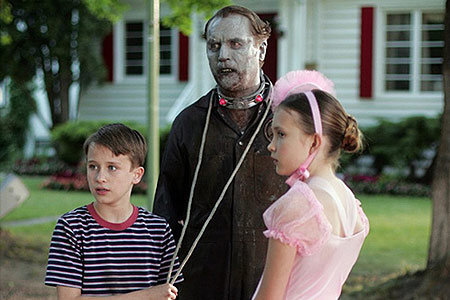
What’s great though, is that Fido allows its protagonists to do incredibly wrong things throughout the film, without ever pulling punches or calling them on it. When Fido, Timmy’s pet zombie (Billy Connolly) kills an old lady (a mean old lady, but still) Timmy doesn’t hesitate to cover it up. When a scheme by two bullies ends with them both being killed, Timmy’s mother drags their corpses into a shed and sets it on fire. When this leads to Timmy’s zombie being taken away, the inevitable plan to rescue him involves damaging a zombie’s collar in the front lobby of ZomCon headquarters, resulting in many, many deaths. And the film’s climax ends with Timmy switching off Fido’s collar to sick him on the ZomCon head of security. All these acts are treated with the exact same level of seriousness and sincerity that you would see from the characters in Lassie or Skipper the Bush Kangaroo. Except neither of those shows had much in the way of brutal, gory murder.
Despite the fact that that is all they ever think about.
A wussier film would have found a way to make none of these deaths Timmy’s fault, or would have included some miraculous escapes to keep Timmy’s conscience clean. Fido doesn’t bother with any of this because the film makers realise that we don’t care. The people who die horribly are people who are either anonymous, or who, while not actually evil, are people we don’t really like all that much.

Okay, this week’s drinking game:
The first shot is controversial. The characters are not under siege in some manner of building, but they are in a fenced off community, and the film’s climax involves that fence being breached.  One of the ZomCon head of security’s  key lines is towards the end, when he says: “Take a look- out there is chaos, and in here, is safety.” So, for that reasons, we’re going to have a shot.
ZomCon is shown as not exactly competent, and is pretty much the villain of the piece, so we’re going to have two shots for that, with a chaser for “Mankind is the real monster”.

The zombies are proper Romero zombies, who are walking dead (One Shot) who move slowly (One shot) and can only be killed by destroying the brain (Head shot). No less than three kiddy zombies are seen in this film, so have yourself two shots for that. And the public information films warning people against trusting the elderly show that the dead rise regardless of whether they were “infected” (Two shots).

Sunday, 6 February 2011

#5 The Walking Dead: You Say Generic Like It’s A Bad Thing

Those of you who’ve been following the blog so far will have come to expect my regular Monday updates. However, it just so happens that this Monday I am going to be in London, and in the event of a zombie apocalypse, those of us in a capital city will be the first to get chowed down by the undead. So I’m posting this early, so that my messy and untimely demise won’t deprive you of my zombie-related thoughts.
If I'm not back in time for next week's blog, come and rescue me
So, this will be my fifth blog, sixth if you count my introductory rant about writers, and their tendency towards thieving bastardry. So, care to take a guess how many zombie apocalypses we’ve looked at in that time?
Well, I’ve done a quick count, and it turns out, none, zero, also, zilch.
No, this isn’t because three of the previous four blogs have featured running zombies- we already had that argument. The zombie thing isn’t in question here. It’s the apocalypse part.
Night of the Living Dead’s zombie outbreak only affected a third of the United Stated. In 28 Days Later, the virus barely got off the British Isles. By the end of Pontypool the infection had only just escaped the eponymous town, and in Left 4 Dead 2 a map shows that there is still a sizeable portion of the United States untouched by necrotic, blood smeared hand.
So clearly it’s time to stop fucking about and starting about a real, honest-to-god Zombie smack down on the entire human race. Ladies and gentlemen, The Walking Dead. Here be spoilers.
Playing It Straight
The Walking Dead is a TV series, based on a comic series, about the zombie apocalypse. And it plays the tropes of the zombie apocalypse straight, absolutely straight. These are zombies straight from the Romero mould. They’re slow, they’re dead, they can only be killed with a headshot and (I had to google this, because the TV series hasn’t made it clear yet) if you die, for whatever reason, you’ll come back as one of them.
There is no clever subversion here, no twist on the rules of the genre. The first couple of episodes play out like the plot of well-made, but pretty formulaic zombie movie. The thing that sets The Walking Dead apart from its peers, is that it’s the zombie movie that never ends. Most zombie movies end with either everyone dying, or with the few surviving characters travelling into the horizon (where, most probably, they will die). But The Walking Dead sticks with those characters, because everytime they go over that horizon, there's another zombie movie waiting to happen. Despite its insistence on playing strictly by the rules laid down by the stories that came before it, The Walking Dead still manages throw some new elements into the mix, while reminding us of what we love about the old ones.
The TV series is very, very pretty. I’d go so far as to say the zombie apocalypse has never looked this good- the zombie make up, the abandoned city streets look better than any zombie movie I’ve seen.
It stars Andrew Lincoln, who you may remember as the likeable-but-useless one in This Life, or the likeable-but-useless one in Teachers. So no prizes for guessing who he’s playing here.
Pictured: The foppish, upper class buffoon from House
Yes, American TV is playing its new favourite game, taking British actors and casting them as American bad asses.
Except Rick Grimes, Andrew Lincoln’s zombie-killing Sherriff, isn’t really a bad ass in the traditional sense, he’s actually something remarkably rare in the zombie genre. He’s a genuinely decent human being. He cares deeply about his family, but is also willing to risk his life to save a stranger who helped him out once, or even the racist psychopath who he feels responsible for.
One of the things the creators of zombie fiction love almost as much as the sweet, sweet thrill of plagiarising each other’s work, is painting human beings as complete bastards who, on the whole, probably deserve to have their dead rise up and devour them.
It’s easy to see why. Writing selfish pricks is a whole lot more fun than writing decent, upstanding folk, and even the good guys are more entertaining when they do the right thing only after exhausting every possible alternative. It makes it easier to create that most precious of storytelling fuels, conflict, and it’s a short cut to making your story seem deep- “See? Are we any better than the zombies? I don’t need to shoot you in the head because I’ve just blown your mind!
Grimes however, is brave, competent, and in short, exactly the sort of person you’d want running your post-apocalyptic survivalist compound.
Assuming that Bruce Campbell isn't available, naturally
Of course, not all the characters are the paragon of virtue that Grimes is, our aforementioned crazy racist being a prime example, but as a rule the characters in this series work together to solve their problems, resolve their differences through discussion and compromise and only occasionally beating the shit out of a guy who abuses his wife.

Brraaaaaiiiiinnns!
The characters don’t just talk, they plan. Every zombie-based problem the characters face is usually followed by a discussion of strategy and the creation of a plan, and it’s usually a pretty good plan.
This isn’t a subversion or even a new addition to the zombie apocalypse story. One of the things I love about the genre is that the characters in a zombie movie, on average, tend to be smarter than the characters in most other horror movies. In Night of the Living Dead, when Ben and Harry get into their dick measuring argument over whether to stay in the house or the cellar, both of them actually have pretty good points, they have strategies that have actually been thought out. Even in Shaun of the Dead, the characters think through their survival strategy, even if that strategy is “Go to the pub”.
Maybe it’s because the stupid ones are the first people to get eaten during a zombie apocalypse, or maybe it’s that the slow moving zombie give us more time to think things through rather than blindly running into a dead end while wearing a white negligee. The fact is, if you’re watching a zombie movie you’re far less likely to get a characters deciding to split up for no other reason than that it lets them get picked off one by one.
For the drinking game rules this week you better not by driving anywhere. Do the characters spend most of the story under siege in some manner of building? Depends, if we’re talking the whole series, no, but several episodes are shaped that way. Take a shot. Are the people coming to rescue you incompetent or more dangerous than the zombies? I don’t want to give too much away, but take a shot. The zombies are walking dead (the clue is in the name) move slowly, can only be killed by destroying the brain and rise regardless of the course of dead. Take four shots. Then two more for the kiddy zombie in the pilot episode. And while the word zombie doesn't remain unspoken, people tend to call them "walkers" instead, so what they hell, take another two shots. But you know what, this week, I don’t think mankind IS the real monster. Doesn't that make you feel all warm and fuzzy?
Assuming I make it back from the capital alive, I will see you next week.